Intel will ‘focus’ less on buying back company stock: CEO Pat Gelsinger

NEW YORK (Reuters) – The chief executive of the biggest U.S. chip-maker, Intel Corp, said the company is going to curb its focus on buying back its own stock.

“We will not be anywhere near as focused on buybacks going forward as we have in the past,” Intel Chief Executive Officer Pat Gelsinger said in an interview on the CBS news magazine “60 Minutes” to air on Sunday night.

Gelsinger’s comments were in response to a question comparing how much Intel has spent buying its own stock compared to its investment in research and development.

A global shortage of semiconductor chips, critical in cars, laptops and other major consumer products, has put a spotlight on Intel, the only major U.S. chip manufacturer.

In the first quarter, Intel spent $2.3 billion on share repurchases, according to Bloomberg, which first reported Gelsinger’s comments.

The new CEO said in March that Intel will spend up to $20 billion to build two new factories in Arizona, greatly expanding its advanced chip manufacturing capacity. The majority of chips are currently produced in Asia.

According to a transcript of the “60 Minutes” interview, Gelsinger said Intel is also planning to reconfigure some factories to make chips for cars. Ford Motor Co, General Motors Co and other automakers have cut production due to the shortage.

Intel’s board of directors support the move to curtail stock buybacks, Gelsinger said.
Read Complete Article

In Apple versus Epic Games, courtroom battle is only half the fight

By Stephen Nellis

SAN FRANCISCO (Reuters) – Epic Games faces an uphill legal battle against Apple Inc in an antitrust trial starting Monday, and a defeat for the maker of “Fortnite” could make it harder for U.S. government regulators to pursue a similar case against the iPhone maker, legal experts said.

But win or lose at the trial, Epic, which has pursued an aggressive public relations campaign against Apple alongside its court pleadings, may have already accomplished a major goal: Drawing Apple squarely into the global debate over whether and how massive technology companies should be regulated.

Apple has mostly succeeded in staying out of the regulatory crosshairs by arguing that the iPhone is a niche product in a smartphone world dominated by Google’s Android operating system. But that argument has become harder to sustain with the number of iPhone users now exceeding 1 billion.

Epic alleges Apple has such a strong lock on those customers that the app store constitutes a distinct market for software developers over which Apple has monopoly power. Apple is abusing that power, Epic argues, by forcing developers to use Apple’s in-app payment systems – which charge commissions of up to 30% – and to submit to app-review guidelines the gaming company says discriminate against products that compete with Apple’s own.

“It’s not a super-strong suit – I don’t think they are likely to win,” said Rebecca Haw Allensworth, a law professor at Vanderbilt Law School. “But it has already achieved a lot of its purpose, which is drawing attention to some of Apple’s practices that many developers see as abusive.”

Read Complete Article

Amazon to raise pay for more than 500,000 workers to attract more workers

Amazon said Wednesday that it plans to give more than 500,000 of its workers a raise as it seeks to attract new workers.

The online shopping giant, which already pays new hires at least USD15 an hour, said it will start increasing pay between 50 cents an hour to USD3 an hour starting next month.

Those getting raises include warehouse workers, who pack and ship orders, as well as those who work in Amazon’s package sorting centers and other facilities.

Amazon said the pay raise is part of its push to hire more workers. The company has needed more people to get orders to shoppers during the pandemic as Americans increasingly shop online.

It hired 500,000 people in 2020 alone, bringing its total workforce to nearly 1.3 million people worldwide.

The pay announcement also comes after a failed union push at a Alabama warehouse, which put a national spotlight on working conditions at Amazon.

Pro-union workers and organisers in Alabama said they wanted better pay and more breaks in their 10-hour shifts.

Earlier this month, Amazon founder Jeff Bezos acknowledged in a shareholder letter that the company could to do better for its workers and said he didn’t take comfort in the outcome of the union election in Alabama.

Other retailers have been boosting pay, too. Costco, for example, recently raised its minimum wage to USD16 an hour. And Target recently raised its starting pay to USD15 an hour.

Seattle-based Amazon is the second-largest private employer in the U.S. behind retail rival Walmart.

Read Complete Article

India public cloud end-user spending to touch $4.4 billion in 2021: Gartner

End-user spending on public cloud services in India is expected to touch USD 4.4 billion in 2021, an increase of 31.4 per cent over the previous year, according to research firm Gartner.

This is expected to grow further to USD 5.62 billion in 2022, Gartner said in a statement.

The continued trend of increased remote workers in 2021, will lead to an increase in spending on desktop-as-a-service (DaaS) and infrastructure-as-a-service (IaaS).

These segments are forecast to grow 47.7 per cent (to USD 73 million) and 52.2 per cent (to USD 1.44 billion), respectively.

Indian chief information officers (CIOs) saw the benefits of cloud during the first wave of the pandemic in 2020, Gartner research vice president Sid Nag said.

“To build business resilience and minimize the impact of continued disruptions, investing in cloud is unavoidable. India has experienced consistent double-digit growth in cloud spending over the last three years, the pandemic only expedited the shift,” he added.

Spending on Cloud Business Process Services (BPaaS) is expected to grow 9.2 per cent to USD 207 million, Cloud Application Infrastructure Services (PaaS) by 30.5 per cent to USD 997 million, Cloud Application Services (SaaS) by 20.8 per cent to USD 1.41 billion, and Cloud Management and Security Services by 18 per cent to USD 317 million in 2021.

Gartner said spending on SaaS and cloud management and security services will experience double digit growth in India for the first time.

“SaaS has been pivotal in supporting the sudden increase in the mobile workforce, as well as customers, in 2020. Learning from this, Indian CIOs will continue to build on the above trend as they move towards a composable business environment,” Nag said.

Within SaaS, customer experience and relationship management and content services will be the highest growing segments in 2021, forecast to grow 24.9 per cent and 26.1 per cent, respectively, as per Gartner.

Read Complete Article

At 199 million, Twitter logs 20% user growth as pandemic posts surge

Twitter now has 199 million average monetisable daily active users (mDAU), a 20 per cent growth (year-on-year), driven by ongoing product improvements and global conversation around the pandemic.

The micro-blogging platform reported $1.04 billion in revenue for the Q1 2021, up 28 per cent (on-year), and a net income of $68 million. The advertising revenue reached $899 million, an increase of 32 per cent.

“People turn to Twitter to see and talk about what’s happening, and we are helping them find their interests more quickly while making it easier to follow and participate in conversations,” Twitter CEO Jack Dorsey said in a statement late on Thursday.

Total ad engagements increased 11 per cent year-over-year while cost per engagement (CPE) increased 19 per cent year-over-year.

While US revenue reached $556 million, international revenue totalled $480 million, an increase of 41 per cent.

“Advertisers continue to benefit from updated ad formats, improved measurement, and new brand safety controls, contributing to 32 per cent year-over-year growth in ad revenue in Q1, said Ned Segal, Twitter’s CFO.

The mDAU were 199 million for Q1, compared to 166 million in the same period of the previous year and compared to 192 million in the previous quarter.

Average international mDAU were 162 million for Q1, compared to 133 million in the same period of the previous year and compared to 155 million in the previous quarter.

“We are attracting more great people to Twitter than ever before and investing in our highest priorities to deliver on our long-term goals across consumer product, revenue product, and platform,” the company said.

Read Complete Article

Google Lens can now translate text from screenshots on Android 11 devices

Google Lens can now automatically translate texts in screenshots for devices running Android 11 or above.

According to 9To5Google, users can now take a screenshot of a foreign language and let Google Lens do the translation without any intermediate step.

The exciting new feature is available on the Google Lens Screenshot UI for devices running Android 11+.

The translate button will become visible on the screenshot and a click on it will detect and translate the required text quickly.

Google continues to release innovations that are bound to help it maintain its edge among its competitors, GizmoChina reported on Tuesday.

In addition to translating the text, users can also copy the text on the screenshot, which can then be downloaded for offline access or shared on the Google Translate app or social networks like Twitter or Instagram.

Users can also download the current language for offline access and can also swiftly send the screenshot to the full Google Translate app, the report said.

Google Lens was first unveiled at Google I/O 2017. It is an image recognition tool that was first integrated with Google Assistant on Pixel 2 and Pixel 2 XL.

It was later in 2018 integrated with Google Photos for both Pixels and other Android devices.A

The app was released as a standalone app on the Play Store in June 2018 and as of January this year, the app had recorded over 500 million downloads.

Read Complete Article

Samsung unveils Galaxy Book Pro laptops with 11th Gen Intel Core processors

Aiming to boost its laptop users, Samsung Electronics on Wednesday unveiled two new laptops, Galaxy Book Pro and Galaxy Book Pro 360, under its Galaxy Book Pro series, which is designed around the needs and routines of modern mobile-first users.

Both the laptops under the Galaxy Book Pro series will be available in two variants — 13-inch and 15-inch — and are Samsung’s first-ever Windows PCs with Super AMOLED displays.

“The new Galaxy Book Pro series offers true mobile computing for the connected world, enabling ultra-light, yet mighty portability, boundless connectivity and a window into your wider Galaxy ecosystem,” TM Roh, President and Head of Mobile Communications Business, Samsung Electronics, said in a statement.

The Galaxy Book Pro Series is powered by next-generation hardware, including an 11th Gen Intel Core processor and Intel Iris Xe graphics.

The Galaxy Book Pro series is verified to the Intel Evo platform, signifying an industry-leading balance of power, immersive graphics, always-on connectivity, and long-lasting battery life.

According to Gregory M. Bryant, Executive Vice President & General Manager of the Client Computing Group at Intel, the new Galaxy Books are the thinnest 13-inch and 15-inch Intel Evo designs ever and delivers on the Evo promises of responsiveness, instant wake and long battery life.

Both the laptops also offer custom Bluetooth enablement and industry-leading connectivity including 5G and Wi-Fi 6E capabilities.

With Studio mode, users can enjoy video call environments that help them look as they prefer regardless of your setting.

Quick Share for the Galaxy Book Pro series allows you to share content between your Galaxy devices or with classmates and coworkers in just a few clicks.

Read Complete Article

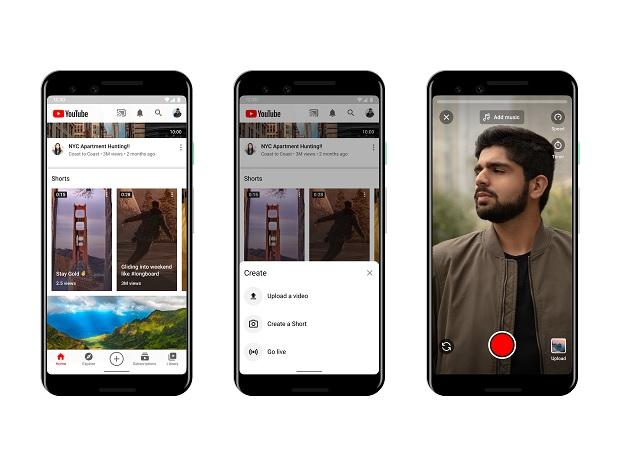
TikTok rival short form videos app YouTube Shorts hits 6.5 bn daily views

YouTube Shorts which is a TikTok-like short form video app continues to gain popularity with over 6.5 billion daily views as of March, up from 3.5 billion at the end of 2020, the company has announced.

YouTube had rolled out Shorts app feature in India in September last year.

Shorts is a new short-form video experience right on YouTube for creators and artists who want to shoot short, catchy videos using nothing but their mobile phones.

The company later rolled out the video streaming service on its platform in the US in Beta.

With over 2 billion monthly logged in users and over 1 billion hours of video watched every day, Google-owned YouTube is offering advertisers efficient reach to large audiences which are incremental to those found on TV.

“With respect to YouTube, people continue to find all types of informational content, from educational videos to podcasts,” Alphabet and Google CEI said during the company’s earnings call on Tuesday.

According to the company, it is also seeing strong growth in YouTube’s brand business, fuelled by global consumer trend from linear TV towards streaming video.

“YouTube is offering advertisers efficient reach to large audiences which are incremental to those found on TV. Large brands are benefiting from this trend,” the company informed.

The company said that YouTube advertising revenues of $6 billion in the January-March period of 2021, up 49 per cent, is driven by exceptional performance in direct response and ongoing strength in brand advertising.

Read Complete Article

Microsoft Teams now has 145 mn daily active users globally: Satya Nadella

Driven by online work and learning amid the ongoing pandemic, Microsoft Teams now have 145 million daily active users globally, almost double the number a year ago, CEO Satya Nadella informed.

The number of organisations with more than 1,000 users integrating their third party and line of business applications with Teams has increased nearly three times year-over-year.

“In markets where employees have returned to the workplace including Australia, China, New Zealand, South Korea and Taiwan, we have seen usage continue to grow,” Nadella said during the company’s earnings call late on Tuesday.

The company has added more than 300 features in Teams over the past year, including more than 100 new capabilities so far in 2021.

New inclusive meeting experience for hybrid work including custom gallery views enable anyone to be seen, heard and participate whether they are at home, in a meeting room, at an office or on a factory floor.

“Customers like GM and Sanofi are using Teams for unified communications including for voice. Teams is extending beyond communications, creating an entirely new category of modern collaborative applications as organizations use Power Platform to build custom apps, bots and workflows within Teams,” informed Nadella.

“We added support for shared workspaces with people outside the organisation and we are seeing Teams used for everything from virtual retail showrooms and personal shopping to interactive webinars,” he added.

Read Complete Article

Samsung expands its smartphone line-up in Indian with multiple new launches

Samsung Electronics has expanded its presence in the Indian smartphone market in the first quarter of the year on the back of multiple new handsets, a report showed Tuesday, as the South Korean tech giant aims to fend off challenges from Chinese players.

Samsung represented 20 per cent of the smartphone shipments in India in the first quarter, up from 16 per cent a year earlier, according to market researcher Counterpoint Research.

Among the top five brands, Samsung posted the highest on-year growth in smartphone shipments in the first quarter.

“Samsung remains the second-largest brand for India’s smartphone shipments with 52 percent on-year growth driven by its focus on the budget segment with the new M02 series and multiple other launches,” the market researcher said.

“It refreshed its A-series with the A32, A52 and A72, and the M-series with the M12. It also launched its latest flagship Galaxy S21 series earlier than its normal launch period.”

The company remained in the runner-up spot in the Indian smartphone market but managed to narrow the gap with top player Xiaomi, whose market share declined to 26 per cent from 31 percent a year earlier.

Samsung was the only non-Chinese brand in the top five. Vivo came in third with 16 per cent, followed by realme and OPPO with 11 per cent each.

Read Complete Article