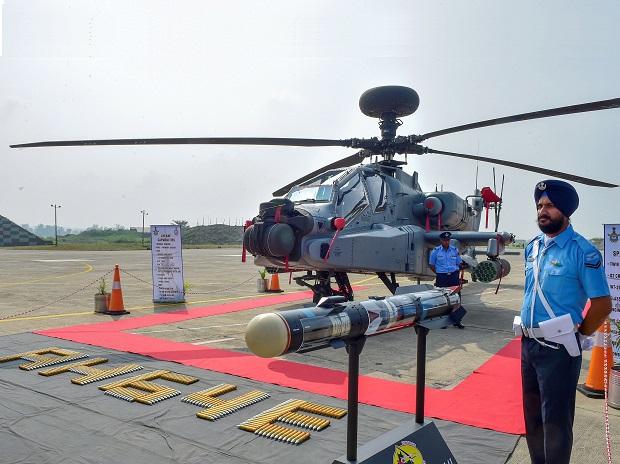
The Indian Air Force inducted eight US-made Apache AH-64E attack helicopters here on Tuesday, which will give a major boost to its combat capabilities.
Officials said the aircraft were formally inducted at the induction ceremony at Pathankot Air Force station with Air Chief Marshal B S Dhanoa as the chief guest.
The AH-64E Apache is one of the world’s most advanced multi-role combat helicopters, and is flown by the US Army.
“Eight of the Apache attack helicopters inducted into the IAF, that will enhance the force’s combat capabilities,” a senior IAF official said.
The ceremonial key was handed over by the Boeing company.
The IAF had signed a multi-billion dollar contract with the US government and Boeing Ltd in September 2015 for 22 Apache helicopters.
On
February 1, two experienced Indian
Air Force
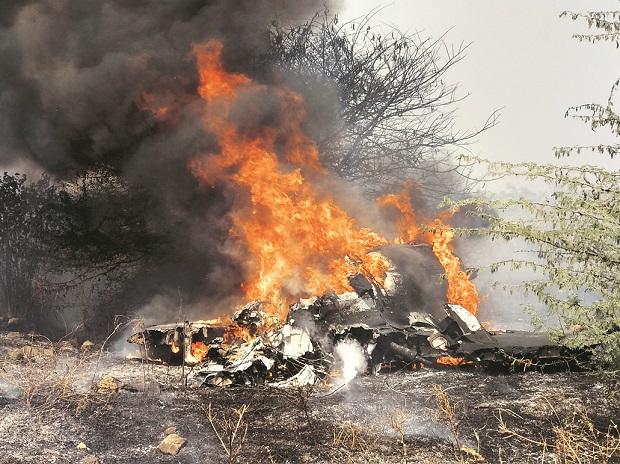
(IAF) pilots died when their newly upgraded Mirage 2000-I fighter
crashed while taking-off in Bengaluru. A Court of Inquiry (CoI)
investigating the accident is now confronting the worrying
possibility of a glitch in the Mirage 2000’s flight computer that
kicks in without warning, causing the aircraft to behave
unpredictably.
IAF
flight records examined by the CoI have revealed at least four such
incidents in the past. In each of these, a flying Mirage 2000 has,
suddenly and without command from the pilot, jerked its nose towards
the ground. Then, as spontaneously, the nose was jerked upwards. Each
time, the aircraft has continued this up-and-down jerking — termed
“pitch oscillations” — for several seconds before resuming
normal flight.
Members
of the CoI from the IAF, Hindustan Aeronautics (HAL), the National
Aeronautics Laboratory (NAL) and the Aeronautical Development Agency
(ADA) are veering round to the belief that such an incident caused
the February 1 crash.
In
three recorded incidents, the “pitch oscillations” took place at
high altitudes, giving the aircraft time to correct itself. However,
on February 1, the ill-fated Mirage 2000-I’s flight computer jerked
the fighter’s nose down just after it lifted off the runway. With
the aircraft barely five metres off the runway, it had no time, or
altitude to correct itself. In a fraction of a second, the nose
slammed onto the runway, the front undercarriage (nose wheel) sheered
off, and the aircraft careened across the runway, fatally out of
control.
In
facing “pitch oscillations” when their aircraft was five metres
above the ground, the two pilots who died were unluckier than several
predecessors whose aircraft misbehaved at higher altitudes. An
incident recorded in 1989 recounts that Mirage 2000, aircraft number
KF138, experienced “sudden and momentary pitch oscillations…
(for) a few seconds” at an altitude of 4,500 feet some 16 minutes
after take-off. The oscillations exerted a violent force of “+10.5g
to -6g” (“g” indicates the force of gravity) on the pilots and
caused the cockpit’s red and amber warning lights to glow.
 Mansa
Mansa 