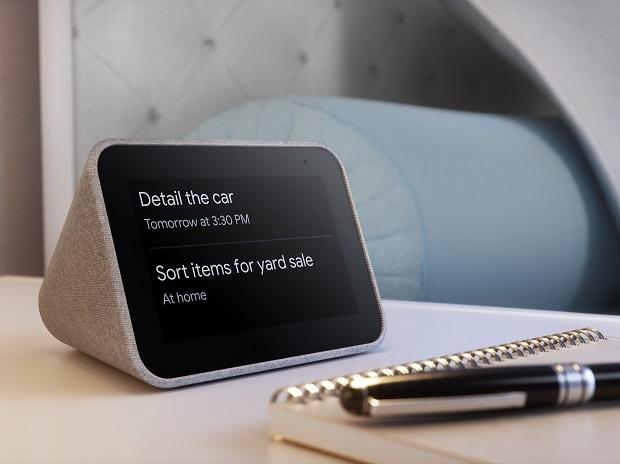
Lenovo today launched Google Assistant-enabled Smart Clock and Lenovo Smart Display, marking its debut in smart home product portfolio in India. The Smart Clock starts from Rs 5,999 while Smart Display starts at Rs 14,999. Both the devices will go on sale from early September 2019.
The announcement came after Google’s Nest Hub smart display speaker was launched in India for Rs 9,999. Lenovo Smart Clock comes with the 4-inch IPS touch screen and can be used to control the smart home and listen to music. The Smart Display can be also be used for video calling using Google Duo among other features.
Lenovo Smart Clock
Precied at Rs 5, 999, Lenovo’s Smart Clock comes with voice and touch control on a 4 inch IPS screen, and can be used to set alarms, set calendar entries, dim the lights, weather information, music, audiobooks, podcasts and radio. The smart clock also works with Google Chromecast. Read Complete Article
Leading smartphone brands such as Xiaomi, Micromax, Redmi (a sub-brand Xiaomi) and OnePlus are set to disrupt the smart television space, which has so far been dominated by electronics giants Sony, LG, Samsung and Panasonic. Internet-enabled smart TVs, which are a relatively new segment in India, are expected to see a major boost on the back of lower data tariffs, which have resulted in a massive uptick in online video consumption.
While Xiaomi is already present in this space, its sub-brand Redmi, whose smartphones are quite popular in India, is expected to launch smart TVs soon. Given the value it offers for its price point in the smartphone space, Mi TVs are also likely to be available at competitive prices.
This week, OnePlus, the maker of the hugely popular OnePlus 6 and OnePlus 6T handsets, too announced that it would come out with smart TVs in September. The Chinese phone-maker is expected to woo consumers with smart TVs that are as aggressively priced as its feature-rich phones. Read Complete Article
Breaking the 10-year history of naming Android releases after desserts, Google on Thursday announced it had officially named the next version as just Android 10.
“First, we’re changing the way we name our releases. Our engineering team has always used internal code names for each version, based of tasty treats, or desserts, in alphabetical order,” said Sameer Samat, VP of Product Management, Android, in a statement. The naming tradition has become a fun part of the release each year externally too, like Android Lollipop or Marshmallows. New Android 10
“As a global operating system, it’s important that these names are clear and relatable for everyone in the world. So, this next release of Android will simply use the version number and be called Android 10,” Samat explained.
“While there were many tempting ‘Q’ desserts out there, we think that at version 10 and 2.5 billion active devices, it was time to make this change,” he added.
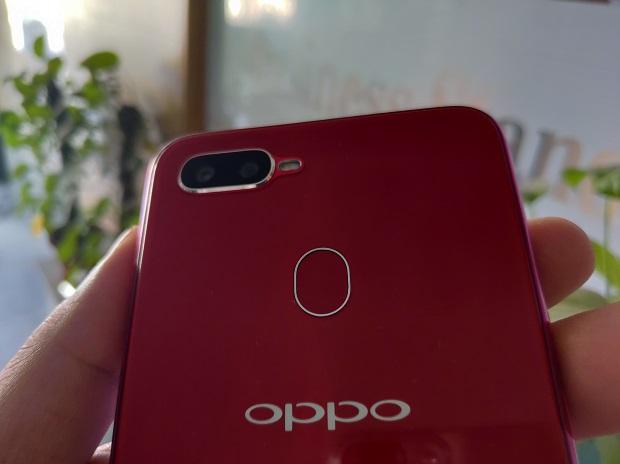
OPPO has announced the rollout of the ColorOS 6 Open Trial Version for its F9 smartphone. The new ColorOS 6 Open Trial Version offers users the latest Android Pie mobile operating system experience, and comes replete with all-new customized features.
Android Pie – a major upgrade
All models upgraded to ColorOS 6 integrate the practical new features introduced by Android Pie, including improved interactions, enhanced AI capabilities and optimization of the underlying interface.
An all-new navigation gesture in Android Pie offers a cutting-edge experience in user interactions. Android Pie is powered by Google’s AI capabilities with Google Assistant, ARcore, Google Lens and other intelligent scenario-based services. OPPO’s integration of the latest software update provides a smoother, smarter and more user-friendly experience for customers.
Google Maps has launched three new, more personalised features for Indian users that will enable them to get better recommendations for dining experiences, and other attractions in and near the location they are in.
The Google Maps app will have an “Explore” tab, “For You” feature, and “Offers”. While the Explore tab has existed for some time, the idea is to provide more personalised suggestions based on search history. “We’ve heard that Indian Maps users prefer a more assertive and visual browsing experience that is easy to access. To reflect this, we have a redesigned, India-focused Explore tab, the For You feature, and dining Offers. This will help Google Maps users discover a new side to their city, whether looking for things to do around town, getting offers on dining out, or getting recommendations that are personalised to their unique tastes,” said Krish Vitaldevara, director, Google Maps.
As part of this update, seven new tabs have been added to the “Explore” tab — restaurants, petrol pumps, ATMs, offers, shopping, hotels and chemists. Google said that 20 million users were engaging with the Explore feature in Maps on a monthly basis. The “Offers” feature will allow users to find deals and discounts at restaurants in 11 Indian cities — Delhi, Mumbai, Bengaluru, Pune, Chennai, Kolkata, Goa, Ahmedabad, Jaipur, Chandigarh, and Hyderabad.
Researchers recently learned that the US Immigrationand Customs Enforcement used facial recognition on millions of driver’s licence photographs without the licence-holders’ knowledge, the latest revelation about governments employing the technology in ways that threaten civil liberties.
But the surveillance potential of facial recognition — its ability to create a “perpetual lineup” — isn’t the only cause for concern. The technological frontiers being explored by questionable researchers and unscrupulous start-ups recall the discredited pseudosciences of physiognomy and phrenology, which purport to use facial structure and head shape to assess character and mental capacity.
Artificial intelligence and modern computing are giving new life and a veneer of objectivity to these debunked theories, which were once used to legitimise slavery and perpetuate Nazi race “science”. Those who wish to spread essentialist theories of racial hierarchy are paying attention. In one blog, for example, a contemporary white nationalist claimed that “physiognomy is real” and “needs to come back as a legitimate field of scientific inquiry”.
On
a recent afternoon at the Lao Thai Kitchen restaurant, the telephone
rang and the caller ID read “Google
Assistant.”
Jimmy Tran, a waiter, answered the phone. The caller was a man with
an Irish accent hoping to book a dinner reservation for two on the
weekend. This was no ordinary booking. It came through Google Duplex,
a free service that uses artificial intelligence to call restaurants
and — mimicking a human voice — speak on our behalf to book a
table. The feature, which had a limited release about a year ago,
recently became available to a larger number of Android devices and
iPhones.
The
voice of the Irish man sounded eerily human. When asked whether he
was a robot, the caller immediately replied, “No, I’m not a
robot,” and laughed.
“It
sounded very real,” Tran said in an interview after hanging up the
call with Google. “It was perfectly human.”
Google
later confirmed, to our disappointment, that the caller had been
telling the truth: He was a person working in a call center. The
company said that about 25 per cent of calls placed through Duplex
started with a human, and that about 15 percent of those that began
with an automated system had a human intervene at some point.
We
tested Duplex for several days, calling more than a dozen
restaurants, and our tests showed a heavy reliance on humans. Among
our four successful bookings with Duplex, three were done by people.
But when calls were actually placed by Google’s artificially
intelligent assistant, the bot sounded very much like a real person
and was even able to respond to nuanced questions.
In
other words, Duplex, which Google first showed off last year as a
technological marvel using AI, is still largely operated by humans.
While AI services like Google’s are meant to help us, their
part-machine, part-human approach could contribute to a mounting
problem: the struggle to decipher the real from the fake, from bogus
reviews and online disinformation to bots posing as people.


 Mansa
Mansa 